
United States Dollar Index trades slightly lower at the start of the US NFP week
- The US Dollar retreats from the two-week high of 99.73 at the start of the US data-packed week.
- Fed Chair Warsh reiterated that policymakers are committed to bringing inflation down.
- The odds of the Fed maintaining the status-quo in September have diminished to 39.4%.
The US Dollar (USD) is slightly down in the Asian trading session at the start of the week. The US Dollar Index (DXY), which gauges the Greenback’s value against its peers, corrects 0.1% to near 99.58 after a strong Friday.
The Greenback gained strongly on Friday as remarks from Federal Reserve (Fed) Chairman Kevin Warsh at the Jackson Hole Symposium signaled that the central bank remains committed to bringing inflationary pressures down to the 2% target, lifting expectations of an interest rate hike in the September policy meeting.
“This summer's inflation data was better than expected, but do not tell me underlying trends have meaningfully changed," Fed Chair Warsh said and added, "Fed's predominant focus right now should be on prices."
According to the CME FedWatch tool, the odds of the Fed leaving interest rates again in the September meeting have diminished to 39.4% from almost 60% seen a week ago.
This week, investors will pay close attention to an array of US economic data, notably the Nonfarm Payrolls (NFP), which will be released on Friday. The data is expected to have a significant impact on the Fed’s interest rate expectations.
On the global front, renewed tensions between the US and Iran have lifted oil prices significantly. The WTI Oil price jumps 2% to near $84.35 at the start of the week, following the exchange of attacks between the US and Iran over the weekend.
The US Central Command (CENTCOM) struck Iranian rocket launchers that were preparing to send mines into the Strait of Hormuz, following weeks of relative calm, Bloomberg reported on Sunday. In retaliation, Iran's Islamic Revolutionary Guard Corps (IRGC) launched ballistic missile strikes on two US bases in Jordan in retaliation for the US attack on Larak Island
US Dollar Index Technical Analysis
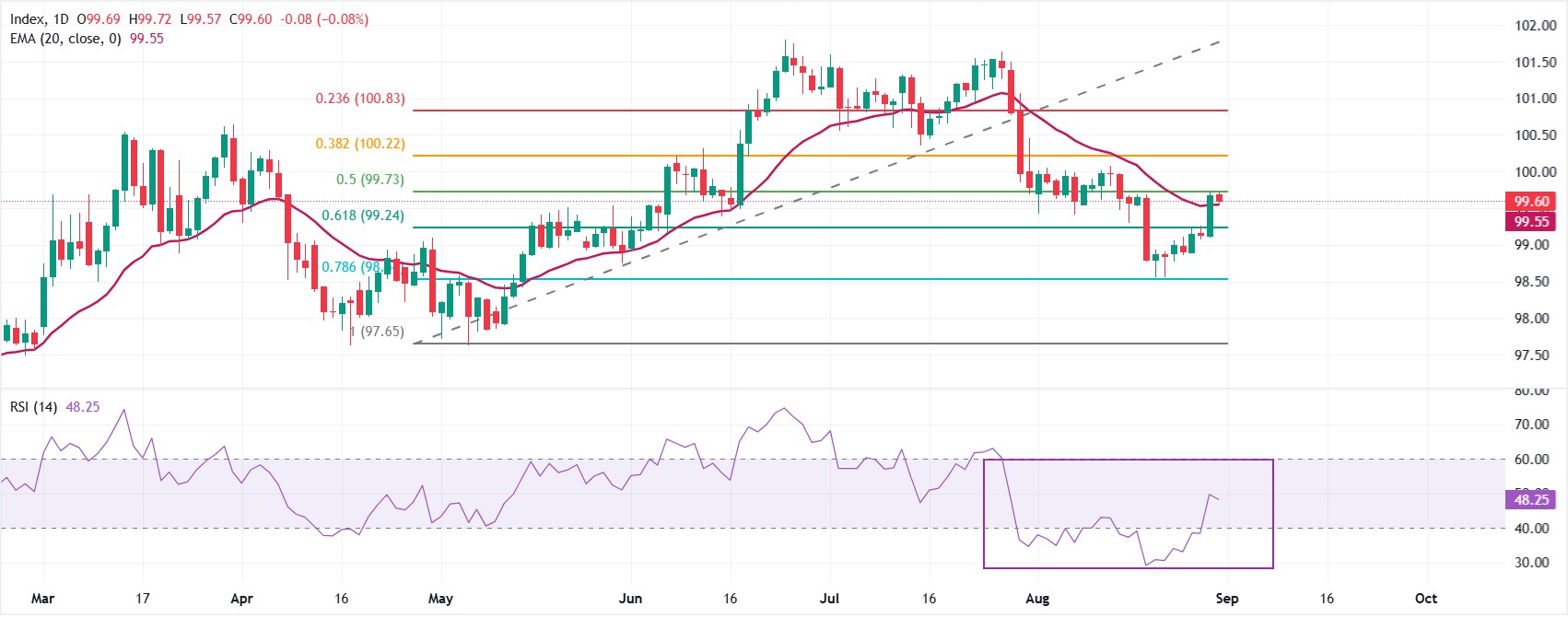
In the daily chart, the Dollar Index Spot trades at 99.60. The near-term tone is neutral to slightly bearish as price holds marginally above the 20-day exponential moving average (EMA) at 99.55 but remains capped by the 50.0% Fibonacci retracement at 99.73. The Relative Strength Index (RSI) at 48.25 hovers just below the 50 line, hinting at fading upside momentum while the index consolidates within the current corrective range.
On the topside, initial resistance is seen at the 50.0% Fibonacci retracement at 99.73, followed by the 38.2% retracement at 100.22 and the 23.6% level at 100.83, where a stronger supply zone could emerge if price extends higher. On the downside, immediate support is provided by the 20-day EMA at 99.55, with the 61.8% retracement at 99.24 and the 78.6% level at 98.54 acting as subsequent cushions ahead of the structural floor near the cycle low around the 100.0% retracement at 97.65.
(The technical analysis of this story was written with the help of an AI tool. Know more.)
US Dollar FAQs
The US Dollar (USD) is the official currency of the United States of America, and the ‘de facto’ currency of a significant number of other countries where it is found in circulation alongside local notes. It is the most heavily traded currency in the world, accounting for over 88% of all global foreign exchange turnover, or an average of $6.6 trillion in transactions per day, according to data from 2022. Following the second world war, the USD took over from the British Pound as the world’s reserve currency. For most of its history, the US Dollar was backed by Gold, until the Bretton Woods Agreement in 1971 when the Gold Standard went away.
The most important single factor impacting on the value of the US Dollar is monetary policy, which is shaped by the Federal Reserve (Fed). The Fed has two mandates: to achieve price stability (control inflation) and foster full employment. Its primary tool to achieve these two goals is by adjusting interest rates. When prices are rising too quickly and inflation is above the Fed’s 2% target, the Fed will raise rates, which helps the USD value. When inflation falls below 2% or the Unemployment Rate is too high, the Fed may lower interest rates, which weighs on the Greenback.
In extreme situations, the Federal Reserve can also print more Dollars and enact quantitative easing (QE). QE is the process by which the Fed substantially increases the flow of credit in a stuck financial system. It is a non-standard policy measure used when credit has dried up because banks will not lend to each other (out of the fear of counterparty default). It is a last resort when simply lowering interest rates is unlikely to achieve the necessary result. It was the Fed’s weapon of choice to combat the credit crunch that occurred during the Great Financial Crisis in 2008. It involves the Fed printing more Dollars and using them to buy US government bonds predominantly from financial institutions. QE usually leads to a weaker US Dollar.
Quantitative tightening (QT) is the reverse process whereby the Federal Reserve stops buying bonds from financial institutions and does not reinvest the principal from the bonds it holds maturing in new purchases. It is usually positive for the US Dollar.